Everyone in the team will be presenting their reflections on the Study Tour. But first here is a fitting prelude by David Law that reflects on the social role of HE...
The
last day of the Study Tour was spent at the University of Antwerp.
This was the day that Paris experienced the atrocities that are bound to
challenge
our willingness to promote cultural inclusiveness in European
universities. Ten days later the peace of Brussels is very much under
threat and the cities within its vicinity, including Antwerp and Ghent
(where the Davis Cup finals will be held), feel the
impact.
At
the University of Antwerp there is a compulsory module, World Views,
for all third undergraduate students taught by staff of the Centre Pieter Gillis. This
Centre is focussed on religious diversity and on the social position of
religion in society. It is named after
Pieter
Gillis (1486-1533) an Antwerp humanist and friend of
Desiderius Erasmus and Thomas More. Unfortunately, because there was so
much to pack in to a half-day visit to the University, we did not have
the chance to meet colleagues from the Centre.
But we were told that all the Flemish universities make provision of
this kind (for the development of ethical and spiritual awareness of
students).
Does any British university require all undergraduates to take such a course, especially at an advanced stage of their degree?
Tuesday, 24 November 2015

Friday, 20 November 2015
Friday 13th November (Day 4): Antwerp
Friday the 13th is considered by some unlucky, but then were are heading to somewhere that is making me hungry just thinking about it: really good beer, waffles, chocolate and amazing chips - yes!
As you can tell, I put on weight whenever I am here (I cannot speak for the rest of the team!)...
Anyway, after a 2 hour train journey we are in the capital of the Flanders province of Belgium, Antwerp. It is renowned for being the world's leading diamond city where over 70% of all diamonds are traded.
The University of Antwerp (Universiteit Antwerpen) was established in 2003, following the merger of the RUCA, UFSIA and UIA institutes, whose roots go back to 1852. As of 2014, the University of Antwerp ranks as 170th globally according to Times Higher Education, 205th according to the QS World University Rankings and in the 301-400th place range according to the Academic Ranking of World Universities.
We are met at the station and driven to one of their outer campuses where much of the adminstration is based. The University was formed by merger, so has a presence on multiple sites.

We then enjoyed and debated a number of excellent presentations on employabilty, internationalisation and research management. Like in the Netherlands, the system here manages to maintain a high consistent standard across its universities.
It became clear, despite a common language, that there are significant policy differences. Again both systems often approach issues in a different way to the UK. The ability to triangulate in this manner has made this study tour quite unique.
In the evening, the University was kind enough to to take us to the University Club where we had a fantastic meal that ended with University branded Belgian chocolates.

So all in all a fitting end to a great study tour.
As always, three observations of the day's conversations.
As you can tell, I put on weight whenever I am here (I cannot speak for the rest of the team!)...
Anyway, after a 2 hour train journey we are in the capital of the Flanders province of Belgium, Antwerp. It is renowned for being the world's leading diamond city where over 70% of all diamonds are traded.
The University of Antwerp (Universiteit Antwerpen) was established in 2003, following the merger of the RUCA, UFSIA and UIA institutes, whose roots go back to 1852. As of 2014, the University of Antwerp ranks as 170th globally according to Times Higher Education, 205th according to the QS World University Rankings and in the 301-400th place range according to the Academic Ranking of World Universities.
We are met at the station and driven to one of their outer campuses where much of the adminstration is based. The University was formed by merger, so has a presence on multiple sites.

We then enjoyed and debated a number of excellent presentations on employabilty, internationalisation and research management. Like in the Netherlands, the system here manages to maintain a high consistent standard across its universities.
It became clear, despite a common language, that there are significant policy differences. Again both systems often approach issues in a different way to the UK. The ability to triangulate in this manner has made this study tour quite unique.
In the evening, the University was kind enough to to take us to the University Club where we had a fantastic meal that ended with University branded Belgian chocolates.

So all in all a fitting end to a great study tour.
As always, three observations of the day's conversations.
- As in the Netherlands, Internationalisation is a strategic activity; though there are some constraints, e.g. limits on what courses can be offered in English, esp. at Bachelors level.
- The research universities have in place reasonably mature employabilty practices as it appears does the vocational/applied HE sector (Belgium has a binary system).
- Research funding has both competitive aspects as well as an allocative compnnet based on simple metrics.
Monday, 16 November 2015
Thursday 12th November (Day 3): Delft
Warning: this blogpost was written by a STEM person, expect some geeking out...
Day three and the intercity train was only 20 minutes - we are now in Delft, known for its historic town centre with canals, Delft Blue pottery, the Delft University of Technology, painter Johannes Vermeer and scientist Antony van Leeuwenhoek.
It is of course the university we are here for...
The Delft University of Technology (TU Delft), is the largest and oldest Dutch public technical university established in 1842 as a Royal Academy to train civil servants for the Dutch East Indies. The school rapidly expanded its research and education activity, becoming first a Polytechnic School in 1864, Institute of Technology in 1905, gaining full university rights, and finally changing its name to Delft University of Technology in 1986. TU Delft boasts connections with Dutch Nobel laureates Jacobus Henricus van 't Hoff, Heike Kamerlingh Onnes and Simon van der Meer.
This was a whole day visit. We started with a number of meetings with staff who worked in the areas of the themes of the tour. After an excellent lunch we started to move around the campus and its facilities, including an absolutely fabulous library building.

Librarian AUA members - wish you were here!
After that we visited the 'D:Dream' building where student teams in their own time build cars, boats, robots and enter them in competitions. They do very well and had lots of impressive machines to show us...

The students get some support and a building from the university but have to raise most of the money from external sponsors. As I was a massive geek I loved it. The other tour members were also impressed.
We then went for a meeting with a member of the senior management team. Afterwards we had the pleasure of visiting TU Delft's startup hub: a purpüose built building to encourage commercialisation, both for current students, but especially for their alumni.

We came into contact with a lot of students today. All were a credit to the university.
As before, here are the three most interesting findings of the day...
Day three and the intercity train was only 20 minutes - we are now in Delft, known for its historic town centre with canals, Delft Blue pottery, the Delft University of Technology, painter Johannes Vermeer and scientist Antony van Leeuwenhoek.
It is of course the university we are here for...
The Delft University of Technology (TU Delft), is the largest and oldest Dutch public technical university established in 1842 as a Royal Academy to train civil servants for the Dutch East Indies. The school rapidly expanded its research and education activity, becoming first a Polytechnic School in 1864, Institute of Technology in 1905, gaining full university rights, and finally changing its name to Delft University of Technology in 1986. TU Delft boasts connections with Dutch Nobel laureates Jacobus Henricus van 't Hoff, Heike Kamerlingh Onnes and Simon van der Meer.
This was a whole day visit. We started with a number of meetings with staff who worked in the areas of the themes of the tour. After an excellent lunch we started to move around the campus and its facilities, including an absolutely fabulous library building.

Librarian AUA members - wish you were here!
After that we visited the 'D:Dream' building where student teams in their own time build cars, boats, robots and enter them in competitions. They do very well and had lots of impressive machines to show us...

The students get some support and a building from the university but have to raise most of the money from external sponsors. As I was a massive geek I loved it. The other tour members were also impressed.
We then went for a meeting with a member of the senior management team. Afterwards we had the pleasure of visiting TU Delft's startup hub: a purpüose built building to encourage commercialisation, both for current students, but especially for their alumni.

As before, here are the three most interesting findings of the day...
- Dutch universities have in play significant programmes to promote start ups and student entreprenurship
- The professional tier of their HE system (Hogschul/Universities of Applied Technology) engages in signficant industrial placement activities.
- Internationalisation though concentrated in masters programmes is picking up pace with some impressive recent recruitment growth.
Wednesday, 11 November 2015
Wednesday 11th November (Day 2): Amsterdam
Onto Day 2. Breakfast then we take advantge of the geographical proximity and great trains between Dutch cities. In little over half an hour we are in Amsterdam to visit two universties.
The first HEI visited has a literal translation of the Dutch name Vrije Universiteit of "Free University". "Free" refers to independence of both state and church. Both within and outside the University, the institution is commonly referred to as "the VU" (pronounced somewhat like "vew" as in "new"). In English, therefore, the university uses the name "VU University". Though founded in 1880 as a private institution, VU has received government funding on a parity basis with public universities since 1970. Abraham Kuyper, Prime Minister of the Netherlands from 1901 to 1905, founded VU University Amsterdam. At first the university was only open to Reformed Christians and was entirely financed by their fund-raising efforts and donations. Since the 1960s, however, VU University Amsterdam has been open to everyone and funded in the same way as the other Dutch universities, although it still retains its tradition of Christian standards and values.
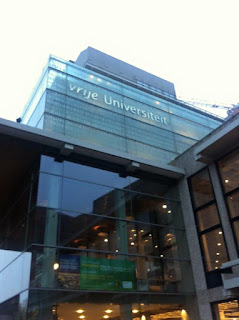
We had a most enjoyable moring there in a building that was reminisent of the Barbican building, followed by lunch and the usual transport problems with tram stations that will not sell tourists tickets...
The afternonn was spent in the University of Amsterdam (UvA) has a rich history dating back to 1632, when its forerunner, the Golden Age school Athenaeum Illustre, was established. In 1815, the Athenaeum Illustre was recognised by law as an institution of higher education and, in 1876, granted the right to confer doctoral degrees and given its current name, the University of Amsterdam. The UvA operated under the executive authority of the City of Amsterdam until 1961, at which time it became an independent public entity. Today, with some 30,000 students, 5,000 staff, more than 100 nationalities and a budget of more than 600 million euros, it is one of the largest comprehensive universities in Europe.
We enjoyed again some great and detailed presentations and discsssions on the themes. The universities so far have prepared very well indeed!

There were some very well designed buildings on their outer campus that we had the pleasure of being shown round. The library was commendably busy even at 6pm!
The three interesting findings from today's visits were:
The first HEI visited has a literal translation of the Dutch name Vrije Universiteit of "Free University". "Free" refers to independence of both state and church. Both within and outside the University, the institution is commonly referred to as "the VU" (pronounced somewhat like "vew" as in "new"). In English, therefore, the university uses the name "VU University". Though founded in 1880 as a private institution, VU has received government funding on a parity basis with public universities since 1970. Abraham Kuyper, Prime Minister of the Netherlands from 1901 to 1905, founded VU University Amsterdam. At first the university was only open to Reformed Christians and was entirely financed by their fund-raising efforts and donations. Since the 1960s, however, VU University Amsterdam has been open to everyone and funded in the same way as the other Dutch universities, although it still retains its tradition of Christian standards and values.

We had a most enjoyable moring there in a building that was reminisent of the Barbican building, followed by lunch and the usual transport problems with tram stations that will not sell tourists tickets...
The afternonn was spent in the University of Amsterdam (UvA) has a rich history dating back to 1632, when its forerunner, the Golden Age school Athenaeum Illustre, was established. In 1815, the Athenaeum Illustre was recognised by law as an institution of higher education and, in 1876, granted the right to confer doctoral degrees and given its current name, the University of Amsterdam. The UvA operated under the executive authority of the City of Amsterdam until 1961, at which time it became an independent public entity. Today, with some 30,000 students, 5,000 staff, more than 100 nationalities and a budget of more than 600 million euros, it is one of the largest comprehensive universities in Europe.
We enjoyed again some great and detailed presentations and discsssions on the themes. The universities so far have prepared very well indeed!

There were some very well designed buildings on their outer campus that we had the pleasure of being shown round. The library was commendably busy even at 6pm!
The three interesting findings from today's visits were:
- There is a binary system in the Netherlands with academic universities and professional Hogschule (in English 'Universities of Applied Technology')
- There seems to be a large number of Germans in Dutch HE (the largest sources of non-Dutch students being the US, German, China and the UK).
- There is a structured series of personal research grants from the Dutch research council, called vini, vidi, vici. Classicists may draw a wry smile at that...
Tuesday, 10 November 2015
Tuesday 10th November (Day 1): Leiden
The team arrived in Leiden. I presume like me by flying into AMS and taking a train. The city is known as the birthplace of Rembrandt, for its beautiful, old city centre and a large population of
students.
We got to the hotel safe and sound, put our bags in safe keeping and heading out to the first HEI on our visit: Leiden University.
We got to the hotel safe and sound, put our bags in safe keeping and heading out to the first HEI on our visit: Leiden University.
Leiden University (abbreviated as LEI, Dutch: Universiteit Leiden) is the oldest university in the Netherlands, founded in 1575 by William, Prince of Orange. It came into prominence during the Dutch Golden Age, when scholars from around Europe were attracted there due to its climate of intellectual tolerance and international reputation. Leiden was home to such figures as René Descartes, Rembrandt, Hugo Grotius, Baruch Spinoza and Baron d'Holbach. It is now a prestigious public research university.
- In 2013 Leiden was the highest ranked university in the Netherlands in the Times Higher Education World University Rankings, where it was rated as the 64th best university worldwide and 61st for international reputation.
- Shanghai Jiao Tong University's 2011 ranked Leiden University as the 65th best university worldwide.
- Times Higher Education Rankings consistently ranks it as the best university in Continental Europe for Arts and Humanities.
We received presentation on each of the three themes as well as an overview of the university and its strategy. Leiden clearly sees itself as an international university..
We also saw their 'Sweat Room' where students sat (and wrote their names on the wall) while waiting for their results. This autograph tradition also extends to honorary degree holders such as Nelson Mandela and Winston Churchill.


We also enjoyed on our tour their lovely Senate Room.

At the end of each day, we share three points that struck us most today about todays visit:
- Dutch PhD positions cannot not funded by studentships but rather by employment contracts (and the PhD candidates appear eager to keep it that way).
- There is a great story to be told about how Leiden is responding to student feedback on enhancing employability for its students.
- Though there are national subject reviews of research with external experts, they do not affect formula funding (though universities do act upon their findings). From a UK REF tradition, and the strong research reputation of Dutch universities, this may be surprising to many.
Monday, 9 November 2015
Why I Joined: Andrew Tuson
Hey, doesn't he seem somewhat familiar....?
Yep, busted. I was the coordinator of the previous AUA Study Tour to Poland (report out now - plug, plug). So in the interests of full disclosure here is the post I did for the last tour.
Anyway, to cut a long story short, I was having a coffee with Els handing over from one coordinator to another. As I was off contract at the time, I mentioned that if (and only if) there was a spare space that I would be happy to join in at my own expense. Els and the AUA said yes, so here I am...
The rest was history. I am paying for my supper by looking after the blog.
That said it is going to be quite a interesting tour especially as Western European HE systems have increasingly been offering degrees in English to compete in the international student market.
Anyway, I have a plane to catch!
Yep, busted. I was the coordinator of the previous AUA Study Tour to Poland (report out now - plug, plug). So in the interests of full disclosure here is the post I did for the last tour.
Anyway, to cut a long story short, I was having a coffee with Els handing over from one coordinator to another. As I was off contract at the time, I mentioned that if (and only if) there was a spare space that I would be happy to join in at my own expense. Els and the AUA said yes, so here I am...
The rest was history. I am paying for my supper by looking after the blog.
That said it is going to be quite a interesting tour especially as Western European HE systems have increasingly been offering degrees in English to compete in the international student market.
Anyway, I have a plane to catch!
Study Tour on the Web: The First of (Hopefully) Many....
Many thanks to the University of Aberdeen's Health Services Research Unit's for their coverage of Marion Malcolm's participation on the study tour,
Subscribe to:
Posts (Atom)